
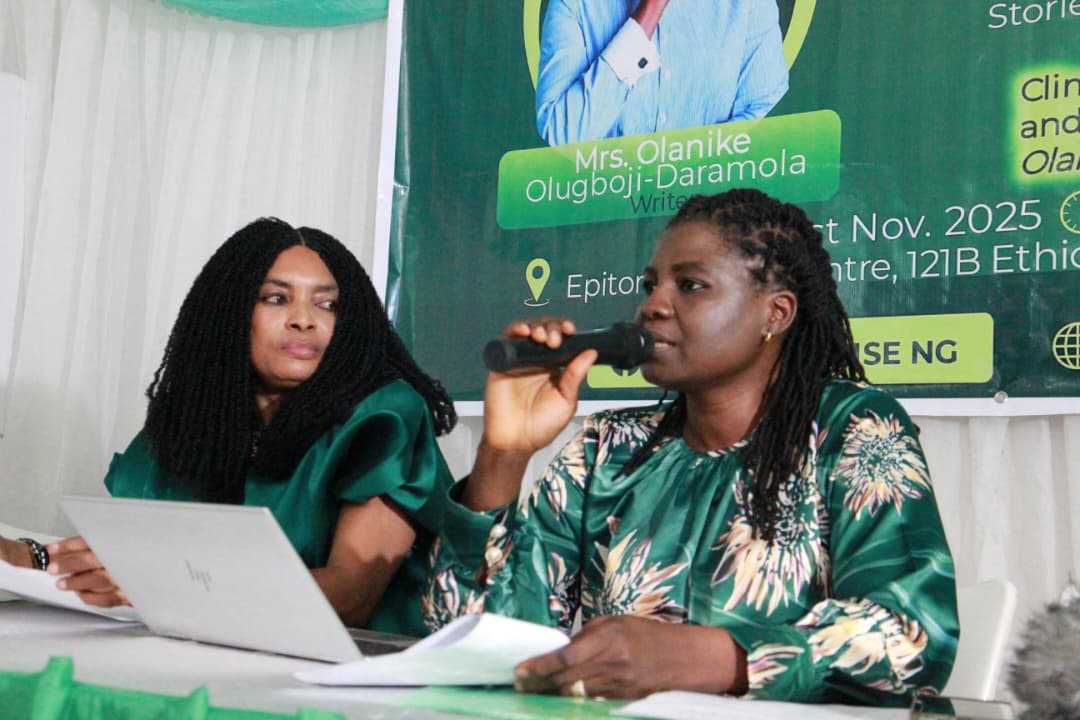
Sometimes, women gather to celebrate. Other times, they gather to heal, learn, reflect and spark change.
Friday, November 21, was one of such powerful moments. The Women Initiative for Sustainable Environment (WISE), in partnership with the Association for Women’s Rights in Development (AWID) and Women’s Earth Alliance (WEA), hosted a deeply engaging Book Reading session as part of the Nigerian Resistance Hub for Climate Justice, themed “COP Missing Voices.”
This initiative represents thousands of voices across the globe and creates a transformative space for climate action—rooted in the real, lived experiences of grassroots women who deserve a seat at the decision-making table.
Mrs. Olanike Olugboji-Daramola, Executive Director of WISE, described the gathering as “our own COP.” Alongside other women and young girls, she read excerpts from her chapter “Climate-Induced Floods: Reinforced Burdens and the Anguish of Rural Women Farmers”—her compelling contribution to The Anthology of Climate Impact Stories in Africa, where she is featured as one of 19 African climate justice writers.
The Book Reading, farm visit, “COP Missing Voices” smallholder farmer dialogue, and the upcoming World Soil Day advocacy form a series of grounded pre-COP30, COP30, and post-COP30 activities.
Unpacking the Impact: A Night of Reflection and Connection
The evening brought together women and young females to explore the emotional, social, and economic weight of climate-induced flooding on rural women farmers.
During breakout group discussions, participants openly examined how these floods intensify burdens such as:
- Loss of property and livelihoods
- Forced migration and displacement
- Emotional and psychological trauma
- Financial strain and indebtedness
- Increased disease exposure
- Disruption of family stability and food security
From Challenges to Solutions: What Can Be Done?
The conversations evolved from storytelling to solution-building, highlighting what communities and policymakers must do to support resilience. Key recommendations included:
✅ Proper drainage systems and improved waste management
✅ Community advocacy and awareness programs
✅ Stronger enforcement of environmental sanitation
✅ Compensation for affected communities
✅ Tree planting and environmentally friendly policies
✅ Stricter laws against illegal tree felling
✅ Construction of dams and flood-control structures
✅ Training women on constructive response techniques
✅ Education on insurance policies to reduce financial shocks
A Night of Learning, Bonding, and Inspiration
Beyond the readings, the session featured an inspiring author biography, group tasks, quizzes, photography and videography moments, and rich networking opportunities.
It was truly a memorable gathering—one that amplified women’s voices, inspired collective action, and reinforced the truth that climate justice is about more than emissions or adaptation. It is about listening to the lived experiences of those most affected.
Communities facing floods, droughts, displacement, and loss of livelihoods must be given space to share their stories. Their perspectives are not optional—they are essential for designing sustainable solutions.
True climate justice ensures that vulnerable groups are active contributors to decision-making, not passive recipients of policies. By amplifying their voices and honoring their knowledge, we build responses that are inclusive, equitable, effective, and transformative.
Climate justice means those who bear the greatest burdens must help shape the path forward. The time to act is now.
Leave a Reply